From Virus to Autoimmunity: The Missing Piece in the Puzzle of Post-COVID-19 Vaccine Blood Clots

The study demonstrated that rare cases of blood clots associated with the adenoviral vector vaccine appear to arise when, in people with a specific genetic predisposition, an antibody initially directed against an adenovirus protein undergoes a slight alteration and begins to attack the body's own platelet factor 4. This discovery identifies, for the first time, the exact possible molecular mechanism behind the condition and explains why it is so rare.
Vaccine-induced thrombosis with thrombocytopenia is an extremely rare condition that has been observed after some COVID-19 vaccines made with an adenoviral vector. Adenoviral vector means that the vaccine uses a modified and harmless version of a common virus, called adenovirus, to teach the body to recognize the coronavirus.
In very few cases, some people have developed blood clots accompanied by a drop in the number of platelets, which are cells responsible for blood clotting.
Previous studies had already shown that these cases involve antibodies, defense proteins produced by the immune system, that attack a protein of the body itself called platelet factor 4. This protein is released by platelets during coagulation. The problem is that, when antibodies bind to it inappropriately, they can overactivate platelets, triggering clot formation.
What was not yet known was: why would the immune system start producing these antibodies against something from the body itself?

To answer this question, researchers analyzed blood samples from over 100 patients who developed this rare condition. They studied in detail the structure of the antibodies present in these people. This was done by identifying the amino acid sequence, the "building blocks" of proteins, that formed these antibodies.
They also sequenced the genes responsible for producing the part of the antibodies that recognizes the targets. This region is the most variable and functions like a "lock" molded to fit a specific "key."
The scientists sought to discover if there was any common genetic characteristic among these patients. They found that many of them shared the same genetic variant that influences the production of the antibody's light chain, one of the two parts that form its structure.
Furthermore, they observed that this variant underwent a small acquired alteration during the immune response. This alteration changes only one amino acid, but it was enough to modify the antibody's behavior.
Next, the researchers investigated whether any protein from the adenovirus used in the vaccine could be involved in the initial process.
To do this, they compared the binding capacity of antibodies to both platelet factor 4 and different adenovirus proteins. They tested isolated viral proteins, rather than the whole virus, to accurately identify which part might be triggering the response.

The results showed something very specific: only the antibodies that recognized an internal adenovirus protein, called protein VII, exhibited characteristics similar to the antibodies that attacked platelet factor 4. This suggested that the immune system may have started by reacting against this viral protein and, after the small acquired mutation, began to mistakenly recognize the body's own protein.
To confirm this hypothesis, the researchers experimentally modified one of the pathogenic antibodies, reverting that small genetic alteration to its original form. When they did this, the antibody lost its ability to cause platelet activation and began to preferentially bind to the viral protein, no longer to the human protein.

This experiment was crucial because it directly demonstrated that this small molecular change was responsible for redirecting the antibody's target.
The authors conclude that the condition occurs when three factors coincide: the presence of a specific genetic variant, exposure to the adenovirus protein, and the emergence of this small acquired alteration in the antibody. It is, therefore, an extremely rare event that depends on a very particular genetic and immunological combination.
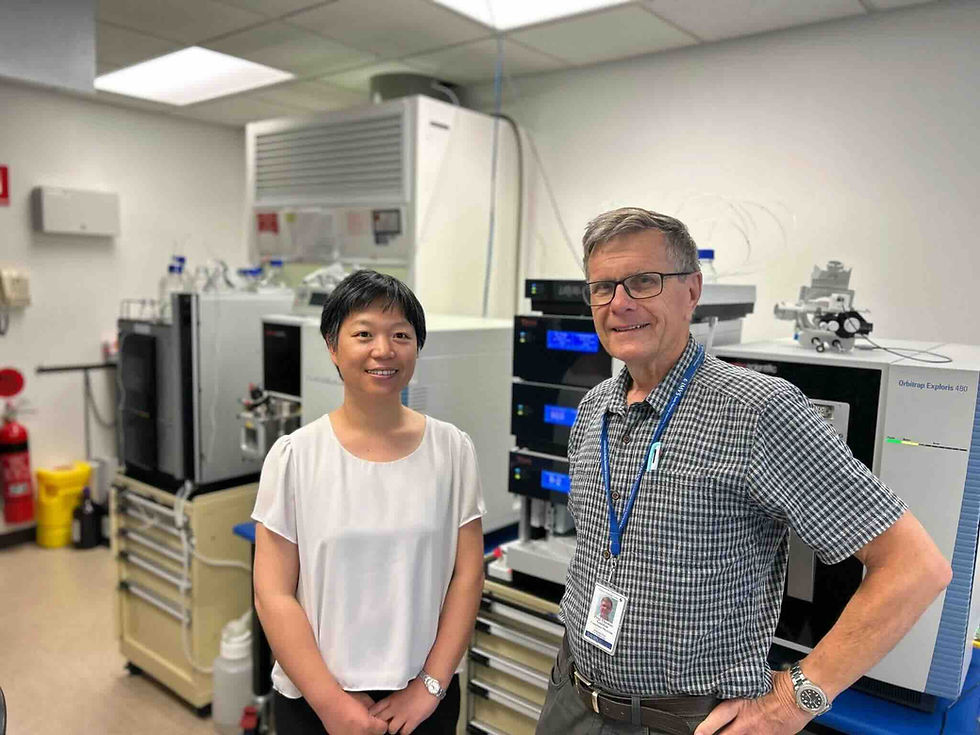
Dr. Jing Jing Wang and Professor Tom Gordon, Principal Investigators at Flinders University and SA Pathology in the Flinders Proteomics Laboratory, FHMRI. Credit: Flinders University
READ MORE:
Adenoviral Inciting Antigen and Somatic Hypermutation in VITT
Jing Jing Wang, Linda Schönborn, Theodore E. Warkentin, Luisa Müller,
Thomas Thiele, Lena Ulm, Uwe Völker, Sabine Ameling, Sören Franzenburg,
Lars Kaderali, Ana Tzvetkova, Alex Colella, Tim Chataway, Chee Wee Tan,
Bridie Armour, Alexander Troelnikov, Lucy Rutten, James McCluskey,
Roland Zahn, Tom P. Gordon, and Andreas Greinacher
N Engl J Med 2026; 394 :669 -683, Published February 11, 2026
DOI: 10.1056/NEJMoa2514824
Abstract:
Vaccine-induced immune thrombocytopenia and thrombosis (VITT) is a rare prothrombotic complication that occurs after adenoviral vector–based vaccination against coronavirus disease 2019; in rare cases, it can also occur after natural adenovirus infection. VITT is mediated by platelet-activating antibodies against the highly cationic protein platelet factor 4 (PF4). The underlying inciting antigen trigger and immunopathogenesis remain unknown.
We used antibody proteomics to determine the amino acid sequences of anti-PF4 antibodies from 21 patients with VITT and sequenced the genes encoding the immunoglobulin light-chain hypervariable region from 100 patients with VITT. To identify an adenoviral trigger, we used the antigen-binding fingerprints of anti-PF4 and anti–adenovirus protein antibodies to identify a shared serum clonotype and subsequently used adenovirus protein peptides and recombinant anti-PF4 VITT antibodies to map the mimicking linear epitope. Genomic and proteomic profiling of VITT antibodies revealed a shared immunoglobulin light-chain allele, IGLV3-21*02 or 03, harboring a critical somatic hypermutation, K31E. Only antibodies purified against adenoviral core protein VII (pVII) contained anti-PF4 species matching the VITT fingerprint; antibodies against intact virions or other adenoviral proteins did not. Cross-reactive IgGs were mapped to a basic linear epitope on pVII. A pathogenic anti-PF4 VITT antibody, back-mutated to germline (K31), lost its prothrombotic activity in vitro and in vivo and preferentially bound pVII, a finding that directly supported the role of the hypermutation in the antigenic shift from adenovirus pVII to PF4. The results of our study indicate that VITT occurs when, in persons with immunoglobulin light-chain allele IGLV3-2102 or *03, a specific somatic hypermutation develops that affects antibodies that recognize a specific epitope on the adenoviral core protein pVII, which results in misdirection of antibody targeting toward PF4. (Funded by Deutsche Forschungsgemeinschaft and others; German Clinical Trials Register number, DRKS00025738; EU Post-Authorization Study Register number, EUPAS45098.)



Comments