Social Learning: Young Orangutans Learn To Build Sophisticated Nests By Watching Adults

Wild orangutans build nests every night to sleep safely and comfortably. Young individuals learn this complex skill over several years, primarily by observing their mothers and, later, other individuals. This social learning ensures they know both how to build a nest and which trees to choose, demonstrating that nest-building is also a cultural behavior passed down through generations.
Like many people, especially those aunts and grandmothers who don't sleep without at least three pillows, a blanket for the cold, another "just for decoration," and a strategic cushion for their lower back, orangutans also take bedtime very seriously. These primates aren't content to simply lie down on any branch: they build veritable beds, complete with "mattresses" made of leaves, "pillows" made of twigs, and even improvised "blankets."
And the most curious thing is that, just as we learn from our mothers and grandmothers the right way to make the bed, young orangutans also learn by observing the more experienced ones, transforming the art of sleeping well into a cultural trait shared between humans and primates.

Wild orangutans need to build nests every day to survive. They do this because nests serve as a bed for resting at night, but also as protection from predators, insects, and even the cold. Sometimes, during the day, they also build smaller nests just to rest a bit.
At night, however, nests are more complex: they can include layers of leaves that function as mattresses, pillows, and even makeshift "blankets." All of this requires strength, dexterity, and a good deal of decision-making, as the nest must be sturdy enough to support the weight of such a large animal.
An important detail is that orangutans don't choose just any tree. They select specific species that offer stronger wood, larger leaves, and even chemicals that can repel insects. This demonstrates the accumulated and passed-on knowledge about which trees are best for each situation.

The base of the nest is covered with a thick lining of branches filled with fresh leaves, a cushion made of leafy branches in a Y shape, and a blanket of short, leafy branches inside a recently abandoned tree nest. Photograph by Junaidi Jaka Permana.
Building a good nest is not just a physical skill; it also involves reasoning and intelligent choices, making this practice a great cognitive challenge.
Orangutan cubs begin to show interest in nests at a very young age, around 6 months old, when they begin to play with leaves and twigs. They try to imitate what they see, but they only begin building simple daytime nests around 1 year of age.
The true practice of more sophisticated nocturnal nesting only begins at age 3, and it takes several years for them to fully master the technique, around 8 years of age. Over time, they also learn to choose the best trees, something that requires experience and observation.
Much of this learning occurs socially. The young closely observe their mothers or other individuals building nests, a behavior called "peeping." Just being nearby isn't enough: it's direct observation, focused on details, that leads the young to practice what they see. Gradually, they transition from observers to builders. Initially, the mother is the primary model, but as they grow, the young begin to observe other members of the group, expanding their repertoire of techniques and materials.

Mother and immature orangutan exploring together / Guilhem Duvot @ SUAQ Project
This type of learning is called "observational social learning." In other words, the infant doesn't just try on its own, but learns by watching how another individual does it. It acquires both the "know-how," such as manipulating branches and leaves for stability, and the "know-what," which trees and materials to choose.
Over time, this becomes a kind of shared culture among orangutan groups: some populations use additional techniques or elements that others don't.
A long-term study of 44 orangutans in Sumatra, followed over 17 years, confirmed this.
Researchers observed that young individuals significantly increased their nest-building practice after watching others build their nests. Younger infants tended to copy their mothers, while older ones sought to learn from different individuals. Even the choice of tree species followed this pattern: first they copied maternal preferences, then explored new options observed in others.
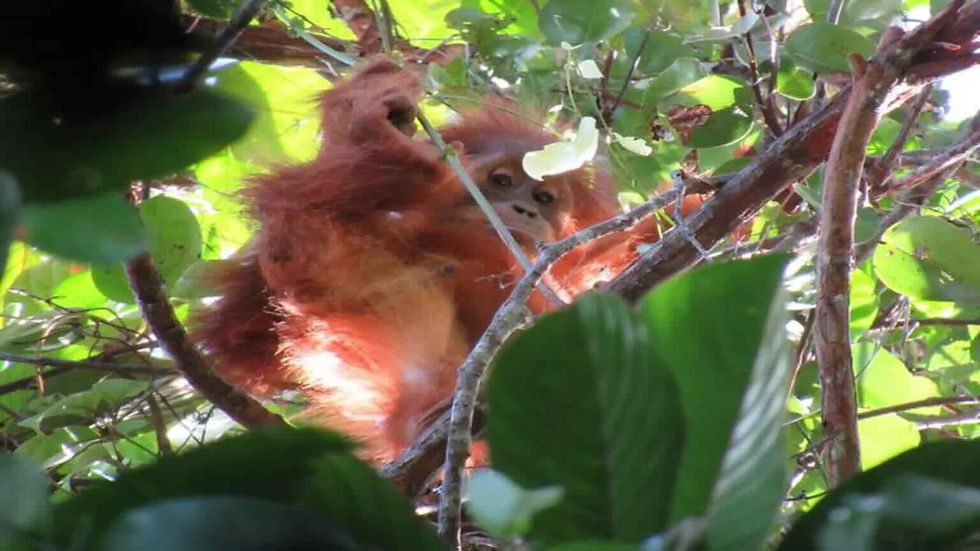
Immature orangutan looking down through branches / Natasha Bartolotta @ SUAQ Project
These findings show that nest-building is not only a practical necessity, but also a complex cultural behavior. Social learning allows knowledge to be passed down from generation to generation, shaping the differences between orangutan groups in different regions.
Thus, what might seem like just a clump of branches is actually a window into how these great apes think, learn, and transmit knowledge within their communities.

Mean nesting rates of dependent immatures in the hour before the mother nests, in the hour after the mother nests (regardless of the immature's distance from the mother when she nests and regardless of whether the immature was spying), in the hour after the mother nests when the immatures were within five meters of the mother when she nests but were not spying, and in the hour after the mother nests when the immature was spying on the nesting mother. Data points represent the mean nesting rate per individual and annual age class for each condition. The size of the data points corresponds to the observed number of nest-building events by the mother for each condition and individual age class. Different colors represent the different focal individuals that contributed data to this analysis (n = 14 dependent immatures).
READ MORE:
Observational social learning of “know-how” and “know-what” in wild orangutans: evidence from nest-building skill acquisition
Andrea L. Permana, Junaidi Jaka Permana, Lara Nellissen, Eggi Septian Prayogi, Didik Prasetyo, Serge A. Wich, Carel P. van Schaik, and Caroline Schuppli
Nature Communications Biology, volume 8, Article number: 890 (2025)
Abstract:
Immature great apes learn how to build their nests over multiple years, yet how they do so has remained largely unclear. We investigated the detailed role of social learning in the acquisition of nest-building skills in wild Sumatran orangutans (Pongo abelii) using data on nest-building, nest practice, and nest peering behaviour from 44 individuals, collected over 17 years. We found that nest peering (but not being close to a nesting individual without peering) is associated with a significant increase in nest practice and is primarily directed at multi-step nest elements. Dependent immatures mostly peer at their mothers and use nest tree species in common with her, independent immatures peer at a larger range of individuals and use nest tree species in common with them. Our results suggest that orangutans acquire their nest-building skills through observational social learning, selective attention to “know-how” and the transmission of “know-what” information.
Creditos das imagens:
Bornean orangutan (Pongo pygmaeus), Tanjung Putting National Park. Thomas Fuhrmann Wikimedia
Interesting engineering;



Comments