Sea, Health, And Long Life: Study Links Proximity To The Ocean To Longer Life Expectancy

Studies show that living near water, such as seas, rivers, or lakes, can improve mental health, increase exercise, and reduce stress. This contributes to a longer, healthier life. In urban areas, living near the sea is linked to a longer life expectancy, while the effects of living near rivers and lakes vary. The study reinforces the importance of including natural spaces in city planning to promote well-being and longevity.
Life expectancy, or the average number of years a person lives, is a very important indicator of people's well-being. The longer life expectancy, the longer people tend to live healthy, quality lives. Therefore, it is also used to measure whether countries are achieving healthy lives for their populations, as envisioned by one of the UN Sustainable Development Goals.
Many factors influence life expectancy: environmental conditions, access to healthcare, income, lifestyle, and other social and economic factors.
Among all these factors, natural environments, especially so-called green spaces (such as parks and forests) and blue spaces (such as seas, rivers, lakes and lagoons), have been gaining prominence for their positive effects on health.

Blue spaces, in particular, are increasingly being studied for their impact on people's physical, mental, and even environmental health. Research has shown that living near water can reduce stress, improve mood, decrease anxiety, and aid mental recovery, as well as promote social interaction and help people better cope with everyday challenges.
Besides the mental health benefits, blue spaces also encourage physical activity, such as walking, running, cycling, or swimming. This contributes to a healthier body, a lower risk of heart disease, obesity, and even a lower chance of dying from various causes.
In cities that have renovated areas near rivers and lakes, for example, a decrease in mortality rates has been observed over the years. This shows that living near water can bring lasting health benefits.

These spaces also benefit the city's environment. They cool the air on very hot days, which is essential for the elderly and other people more vulnerable to heat, and help reduce pollution. Interestingly, even watching videos of waterscapes, such as rivers and waterfalls, can calm the mind and reduce stress, according to recent studies.
Despite so many proven benefits, few studies directly assess whether blue spaces increase life expectancy. And in the United States, this type of research is even more urgent, as life expectancy growth in the country has stagnated or even declined in recent years.
Researchers believe this is linked, in part, to increasing social inequalities. Therefore, public policies such as the "Healthy People 2030" program seek solutions to improve the health and equity of the American population.

Map of the study area.
The study presented investigated precisely this: the relationship between blue spaces and life expectancy in more than 66,000 residential areas in the US. It sought to understand whether living near water influences how long people live, and how this influence changes in different regions, such as urban and rural areas, and with different types of water, such as coastal waters (near the sea) and inland waters (rivers and lakes, for example).
The results showed that living near the sea is linked to a higher life expectancy. Living near inland waters, on the other hand, had more mixed results: in cities, it may even be associated with a lower life expectancy, but in rural areas, the effects were positive.
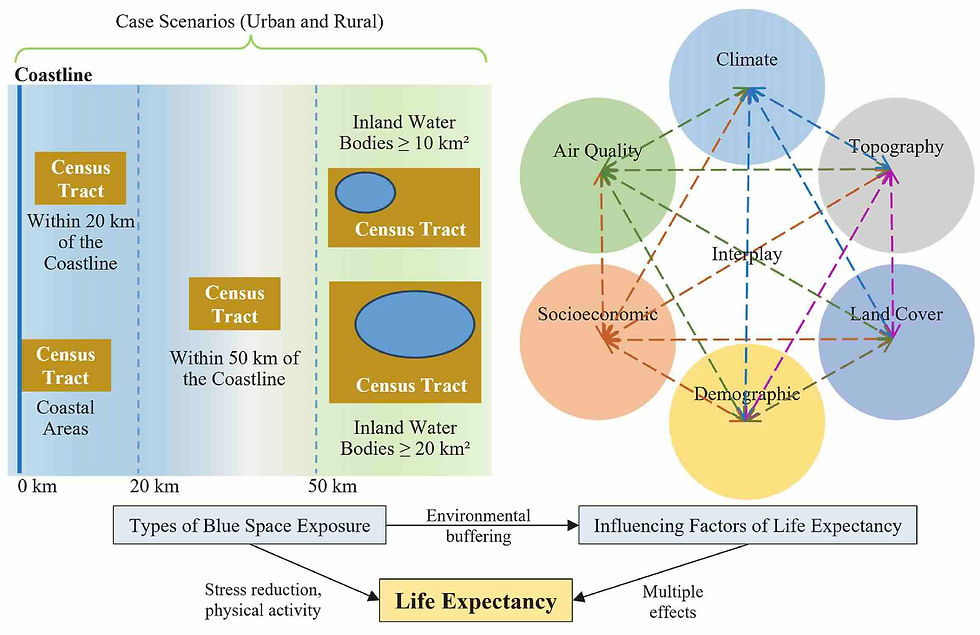
A conceptual framework that links exposure to blue space to life expectancy.
The explanation may lie in the differences in environment and quality of life in these regions. Coastal regions tend to have milder climates, better air quality, more leisure and transportation options, fewer droughts, and generally higher incomes, all of which promote health and longevity.
These findings help show how the environment we live in influences our health and how long we live. They also indicate that urban and environmental planning can use blue spaces as allies to promote longer, healthier lives for all, especially in vulnerable communities.
Considering the presence of rivers, lakes, and seas in public health policies and city design can be an important step toward achieving a more balanced society with a better quality of life.
READ MORE:
Unveiling complexity in blue spaces and life expectancy
Yanni Cao, Ria Martins, and Jianyong Wu
Environmental Research, Volume 281, 15 September 2025, 121981
DOI: 10.1016/j.envres.2025.121981
Abstract:
Although growing evidence supports the positive impact of blue spaces on human health, research on their association with life expectancy remains limited. This study examines the association between coastal and inland waters and life expectancy across 66,263 census tracts in the United States, incorporating socioeconomic, demographic, and geographic factors through multiple linear and multi-level regression as well as spatial regression models, supplemented by sensitivity analyses. Our findings indicate that proximity to coastal waters is positively associated with life expectancy, whereas proximity to inland waters is negatively associated. We used the mutual information model to identify key factors contributing to these differences. Through a comparative analysis of coastal and inland water environments, we found that longer life expectancy near coastal waters may be linked to more favorable environmental and socioeconomic conditions. These include milder temperatures, better air quality, enhanced recreational opportunities, improved transportation, lower drought susceptibility, and higher income levels. The urban–rural analysis further reveals that proximity to coastal waters is positively associated with life expectancy in both settings, whereas inland waters show differing associations, being negative in urban areas and positive in rural areas. In addition to examining these blue space patterns, this study also considers broader socioeconomic and environmental factors related to life expectancy. These findings highlight the importance of integrating blue spaces and other key environmental and socioeconomic factors into urban planning, residential development, and healthcare environment design to improve life expectancy and health equity.


Comments