Reprogramming the Desire to Eat: First Study to Identify the Effect of Mounjaro on the Human Brain

This study investigated how a drug used to treat obesity and diabetes, tirrizepatide (Mounjaro), affects brain areas related to intense food cravings. In one patient, the drug reduced both episodes of food preoccupation and a specific electrical signal in the nucleus accumbens, a region linked to food pleasure. Months later, the signal reappeared before symptoms, suggesting a possible loss of effect over time. These results indicate that this brain signal may function as a marker to monitor or adjust treatments in the future, but more research is needed.
Human eating behaviors are regulated by two major brain systems. The first system is linked to survival and functions when we eat because we truly need energy; this process is called homeostatic feeding. It involves brain areas such as the hypothalamus and parts of the brainstem, which monitor body signals, for example, hunger, satiety, and energy expenditure.
The second system is related to the pleasure we feel when eating certain foods, especially foods high in fat, salt, and sugar, and is called hedonic feeding. This system involves a brain circuit called the mesolimbic circuit, and one of its main structures is the nucleus accumbens.
Although these two systems seem separate, we now know that they interact intensely. This means that real hunger and the desire to eat for pleasure are not independent phenomena, but parts of a single complex system that involves motivation, emotions, and decision-making.

Medications used to treat obesity and diabetes, known as incretin-based therapies, act on receptors present in both the hypothalamus and the nucleus accumbens, suggesting they may influence both hunger and compulsive eating.
Despite this, we still know little about how these medications specifically modify the activity of the food pleasure circuit in humans. When the mesolimbic system functions in a dysregulated way, a person may have repetitive thoughts about food and overreact to food stimuli, such as the smell, memory, or sight of highly palatable foods.
This pattern is called food preoccupation. When food preoccupation is frequent and intense, it can lead to uncontrolled eating behaviors, such as episodes of fast eating, eating in secret, eating even when not hungry, or feeling a lack of control during meals. In more severe cases, this can evolve into binge eating.
This type of symptom is very common: about 70% of people with obesity exhibit some degree of uncontrolled eating. Research suggests that people with binge eating disorder have brains that are even more sensitive to food rewards and exhibit greater impulsivity, especially in areas involved in motivation and impulse control.

Although incretin-based medications have already shown improvement in these symptoms, some studies suggest that the effect may diminish over time, possibly because the brain adapts to the medication. Therefore, it would be useful to detect brain signals that change when the medication is working, allowing for monitoring or adjustment of treatment.
To investigate this, researchers used a technique called intracranial electroencephalography (EEG). Unlike the traditional examination performed on the scalp, this technique directly records the brain's electrical activity through surgically implanted electrodes. This allows for observation of neural signals with great precision.
The participants in this study were people with severe obesity and frequent episodes of loss of control over eating, who had already undergone bariatric surgery but continued to have dysregulated eating behavior.

This figure shows research in which scientists implanted electrodes in the brains of people with binge eating disorder to understand and try to control intense thoughts about food. The first part (a–c) shows where the electrodes were placed: in a region called the nucleus accumbens (NAc), which is linked to craving and reward. Panel (d) shows the treatment timeline, including surgery, medication use, and recordings of brain signals. Images (e) and (f) show graphs comparing brain electrical activity when the person was calm (blue line) and when they were strongly preoccupied with food (pink). Graphs (g) and (h) show that, during these moments of intense food craving, there was more activity in a specific type of brain wave (delta-theta bands). In short, the study attempts to identify a "brain signal" linked to intense food cravings in order to potentially use deep brain stimulation as a treatment for binge eating disorder.
In previous studies with these participants, researchers found a specific type of low-frequency brain activity (between two and eight hertz) in the nucleus accumbens whenever the person reported strong food preoccupation. This type of activity, called delta-theta oscillation, has come to be considered a possible biological marker of risk for episodes of uncontrolled eating.
When the researchers analyzed the data from the first two participants, they observed that, before receiving therapeutic brain stimulation, these delta-theta signals were clearly greater during moments of intense food preoccupation compared to neutral moments.
After months of personalized stimulation, an experimental treatment used to reduce dysregulated eating episodes, the signals decreased and became similar to moments without food preoccupation, while the episodes decreased.

Based on this, the researchers proposed that the presence or increase of this oscillation in the nucleus accumbens could indicate a greater propensity for uncontrolled eating. In the present study, they wanted to investigate whether incretin-based medications, especially tirzepatide (Moujaro), would influence this same neural marker.
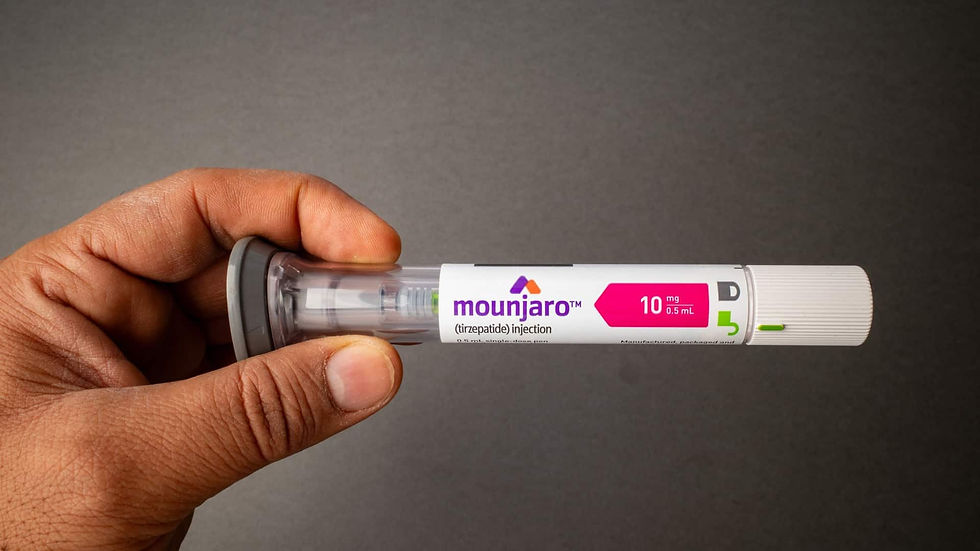
Mounjaro (the trade name for tirzepatide) is a relatively new medication used primarily in the treatment of type 2 diabetes, and it has also shown promising results in weight reduction in obese individuals. It works by mimicking two natural hormones in the body, GLP-1 and GIP, which help control blood sugar, reduce appetite, and slow gastric emptying, making the person feel full for longer.
Clinical studies show that many people using Mounjaro are able to improve glucose levels, reduce food cravings, and lose a significant amount of weight.
The third participant presented an unexpected pattern. After starting tirzepatide (Mounjaro) and increasing the dose, he went months with virtually no episodes of severe eating preoccupation. During this period, the analyzed delta-theta neural signals were absent, meaning they were the same as those recorded during periods of emotional control, which contrasts with the two previous participants.
However, after a few months, even without a change in the medication dose, the neural marker gradually reappeared and preceded the return of dysregulated eating episodes. This suggests that the brain may have lost part of its response to the medication over time, similar to what occurs in certain psychiatric treatments where the effect diminishes after months of continuous use.
These results suggest that incretin-based therapies (Mounjaro) may initially alter the activity of the nucleus accumbens and reduce food preoccupation and loss of control, but that this effect may not be permanent in all cases.
The fact that the neural marker returned before the behavioral symptoms means that it may be useful in the future as a clinical tool to predict relapses or the need for treatment adjustments. Studies in other areas of medicine already use this type of biomarker to monitor neurological diseases, indicating that this method may be a promising avenue.
However, since this study involved only one case and an invasive technique, many questions remain, such as whether this biomarker is universal, whether it applies to all people with obesity, whether the effect is caused directly by the medication in the nucleus accumbens or by other changes in the body, and whether it would be possible to measure similar signals non-invasively, for example, with a traditional electroencephalogram.

Although this study has important limitations, it opens new possibilities for understanding how modern obesity medications act on the human brain. Obesity and associated eating disorders involve not only willpower or personal choices, but brain circuits related to pleasure, motivation, and motor control.
This study shows, for the first time in humans, that medications like tirrizepatide (Mounjaro) can directly modulate these circuits linked to food reward, and that this modulation can be measured. While it is still too early to apply this clinically, the results point to a future where obesity treatments can be guided by customizable neural markers, making medicine more precise and effective.
READ MORE:
Brain activity associated with breakthrough food preoccupation in an individual on tirzepatide
Wonkyung Choi, Young-Hoon Nho, Liming Qiu, Andrew Chang, Gustavo Campos, Robert L. Seilheimer, W. Bryan Wilent, David Bakalov, Nida Firdous, Marie Kerr, Disha Joshi, Gabriella Maze, Uros Topalovic, Daniel Batista, Nanthia Suthana, Anastassia Amaro, Matthew R. Hayes, Iahn Cajigas, Mario Cristancho, Kelly C. Allison, Bijan Pesaran, Katherine W. Scangos, Joshua I. Gold, Thomas A. Wadden, and Casey H. Halpern
Nature Medicine. 17 November 2025
Abstract:
Obesity and related conditions are associated with distressing food preoccupation that often culminates in dysregulated eating behaviors. Incretin-based therapies can reduce excessive weight in obesity, but their impact on dysregulated eating behaviors remains largely unexamined. Understanding how these pharmacologics engage the brain’s mesolimbic circuitry may inform the expansion of their therapeutic potential. We report a rare, first-in-human exploration of the physiological action of these therapies by examining the electrophysiology directly within the human nucleus accumbens. After a short-term course of tirzepatide, the patient-participant exhibited increased severe food preoccupation episodes, which were preceded by an increased delta–theta frequency (≤7 Hz) power in the nucleus accumbens region. We propose that the effects of an incretin-based therapy (tirzepatide) on food preoccupation may be associated with modulation of aberrant activity within this key hub of human mesolimbic circuitry.


Comments