🎗️ Memory May Begin In The Gut: Study Reveals New Link Between Brain And Bacteria

What if one of the causes of memory loss lay not in the brain, but in the gut? Stanford scientists have discovered a surprising link between gut bacteria, the immune system, and memory, and have managed to reverse this process in aging animals. The discovery could pave the way for a new generation of treatments for brain aging.
Aging is a part of life, but one aspect that worries many people is the gradual loss of memory. As the years go by, recalling names, appointments, or recent events can become more difficult.
For a long time, scientists believed this process was driven primarily by changes within the brain itself. Now, a new study by researchers at Stanford University suggests that part of the explanation may lie much further away than previously thought: in the gut.
The research reveals that communication between gut bacteria, the immune system, and the brain may play a significant role in memory aging, opening the door to treatments vastly different from those currently available.
To understand this connection, researchers monitored young and old mice and conducted a detailed analysis of the bacteria present in their guts throughout the aging process. They compared which microorganisms increased or decreased with age and also measured various molecules produced by these bacteria.

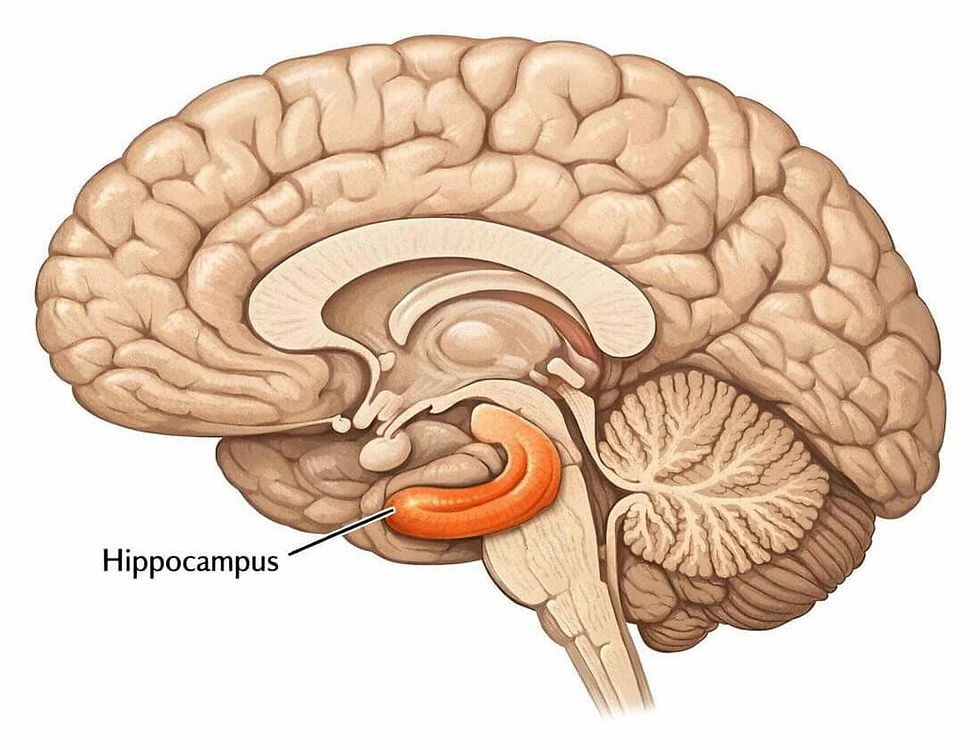
At the same time, they examined how the immune system reacted to these changes and assessed brain function, specifically that of the hippocampus, a region crucial for forming new memories and storing information. The goal was to trace, step by step, the path taken by signals traveling from the gut to the brain.
The results showed that certain bacteria become much more abundant during aging. Among them, a species called *Parabacteroides goldsteinii* stood out. These bacteria produce substances that activate immune system cells, triggering a state of mild yet persistent inflammation. Although this inflammation does not cause obvious symptoms, it interferes with a key communication channel between the gut and the brain: the vagus nerve.
This nerve acts as a veritable "telephone line" between internal organs and the central nervous system, constantly transmitting information about the body's functioning. When these signals reach the brain in a weakened state, the regions responsible for memory begin to function less efficiently.

Scientists also investigated exactly how this change affected the brain. They observed that the hippocampi of older animals showed a reduced capacity to activate specific groups of neurons responsible for recording new experiences. These groups, known to researchers as "engrams", function as clusters of cells that store a memory.
Whenever we learn something new, specific nerve cells are activated together, creating a sort of biological imprint of that experience. With aging and impaired gut-brain communication, these records become less efficient, hindering the formation of new memories.
To determine whether this process could be reversed, the researchers conducted several experiments. In some animals, they used specific viruses that target only certain gut bacteria, thereby reducing their numbers. In others, they blocked a protein involved in the immune system's inflammatory response. They also tested ways to reactivate vagus nerve activity, restoring communication between the gut and the brain.
Following these interventions, the aged mice underwent memory tests designed to assess their ability to recognize objects and recall previously explored environments. In many cases, their performance improved significantly, approaching the levels observed in young animals.

Memory test in mice
Although the results have so far been obtained only in mice, they offer a new way of understanding brain aging. Instead of focusing exclusively on neurons, the study shows that changes occurring in the gut can trigger a sequence of events involving bacteria, the immune system, the vagus nerve, and the brain, ultimately leading to memory loss.
This means that, in the future, therapies targeting the gut microbiota, inflammation, or gut-brain communication could become promising strategies for preserving memory during aging. Studies in humans will still be needed to confirm these results, but the research reinforces an idea gaining increasing traction in the scientific community: taking care of gut health may be one of the most important ways to protect the brain throughout life.

Researcher Christoph Thaiss. Credit: Stanford Medicine

Researcher Maayan Levy. Credit: Stanford Medicine
LEIA MAIS:
Intestinal interoceptive dysfunction drives age-associated cognitive decline
Timothy O. Cox, Ashwarya S. Devason, Alan de Araujo, Sydney Mason, Madhav Subramanian, Andrea F. M. Salvador, Hélène C. Descamps, Junwon Kim, Yixuan Zhu, Lev Litichevskiy, Sunhee Jung, Won-Suk Song, Adrián Cortés-Martín, Nathan T. Henderson, Kuei-Pin Huang, Thao Nguyen, Wisath Sae-Lee, Iboro C. Umana, Maria Sacta, Ryan J. Rahman, Stephen Wisser, J. Andrew D. Nelson, Ilona Golynker, Alana M. McSween, Eric F. Hohmann, Shaan Patel, Anna L. Bub, Clara Soekler, Niklas Blank, Kevt’her Hoxha, Lavinia Boccia, Andrea C. Wong, Klaas Bahnsen, Jihee Kim, Natalie Biderman, Dina Abbasian, Clarissa Shoffler, Christopher Petucci, Fiona E. McAllister, Amber L. Alhadeff, Marc V. Fuccillo, Colin Hill, Cholsoon Jang, J. Nicholas Betley, Guillaume de Lartigue, Virginia Y.-M. Lee, Maayan Levy, and Christoph A. Thaiss
Nature. 11 March 2026. 652, pages 442–450 (2026)
DOI: 10.1038/s41586-026-10191-6
Abstract:
Ageing is accompanied by declining memory function, with extremely heterogeneous manifestation in the human population1. Brain-extrinsic factors influencing cognitive decline, such as gastrointestinal signals, have emerged as attractive targets for peripheral interventions2,3,4,5,6, but the underlying mechanisms remain largely unclear. Here, by charting a high-resolution map of microbiome ageing and its functional consequences throughout the lifespan of mice, we identify a mechanism by which inhibition of gut–brain signalling during ageing results in impaired neuronal activation in the hippocampus and loss of memory encoding. Specifically, accumulation of gut bacteria that produce medium-chain fatty acids, such as Parabacteroides goldsteinii, can drive peripheral myeloid cell inflammation through GPR84 signalling. As a result, the function of vagal afferent neurons is impaired, the interoceptive signal received by the brain is weakened and hippocampal function declines. We leverage this pathway to define interventions that enhance memory in aged mice, such as phage targeting of Parabacteroides, GPR84 inhibition and restoration of vagal activity. These findings indicate a key role for interoceptive dysfunction in brain ageing and suggest that interoceptomimetics that stimulate gut–brain communication may counteract age-associated cognitive decline.


Comments