Goodbye to Needles? Finger Sensor Monitors Parkinson's Medication Through Sweat

A small sensor placed on the finger could change how Parkinson's disease is treated. Scientists have developed a device capable of continuously monitoring levodopa levels in the body using only sweat, without needles or invasive procedures. In the future, this technology could help adjust medication according to each patient's needs, even at home.
Parkinson's disease requires a delicate balance in the use of levodopa, the main medication used to control its motor symptoms. The necessary amount can vary considerably from person to person and throughout the day.
Currently, doctors must rely mainly on symptoms reported by the patient and blood tests performed only periodically. A new study presents an alternative: a flexible device placed on the fingertip that can continuously monitor the amount of levodopa in the body using only sweat.
The device was developed to collect small amounts of sweat naturally produced by the skin, without the need for exercise, electrical stimulation, or any invasive procedures.

Sweat is analyzed by chemical sensors embedded in the device's flexible material. Since the amount of levodopa present in sweat follows the changes observed in the blood, researchers were able to use this information to estimate the levels of the drug in the body. To make the estimates more precise, the system was individually calibrated, taking into account the characteristics of each person.
To test the technology, the researchers compared the information obtained by the device with traditional blood levodopa measurements. Both healthy individuals and people with Parkinson's disease participated, the latter receiving a dose of levodopa combined with carbidopa.
The drug concentrations were determined in the blood using a highly precise laboratory technique and compared with the signals recorded by the device in the sweat.
The results showed a strong correlation between the two measurements, indicating that the small sensor was able to track changes in the amount of drug present in the body.

The wearable device for levodopa monitoring consists of a flexible printed circuit board (left) connected to an adhesive patch (right) that houses a sweat-collecting hydrogel (small white circle), a levodopa sensor (silver bands), and a paper microfluidic channel (wavy line). Credit: David Baillot/UC San Diego Jacobs School of Engineering
Researchers also observed something important for treatment: when the amount of levodopa peaked, patients experienced fewer motor symptoms. At the same time, the study showed that the drug was eliminated from the body more quickly in people with Parkinson's than in healthy participants, although the initial availability of the drug was similar between the groups.
The device also tracked changes in blood pressure, allowing them to observe small drops in pressure that occurred for a short period after medication.
Finally, the scientists used machine learning to combine different information collected by the system, including levodopa levels in sweat and changes in blood pressure. This combination improved the ability to estimate the amount of medication present in the blood. The average error in the predictions was approximately 2.02 micromolar, a result that researchers consider promising for the development of the technology.
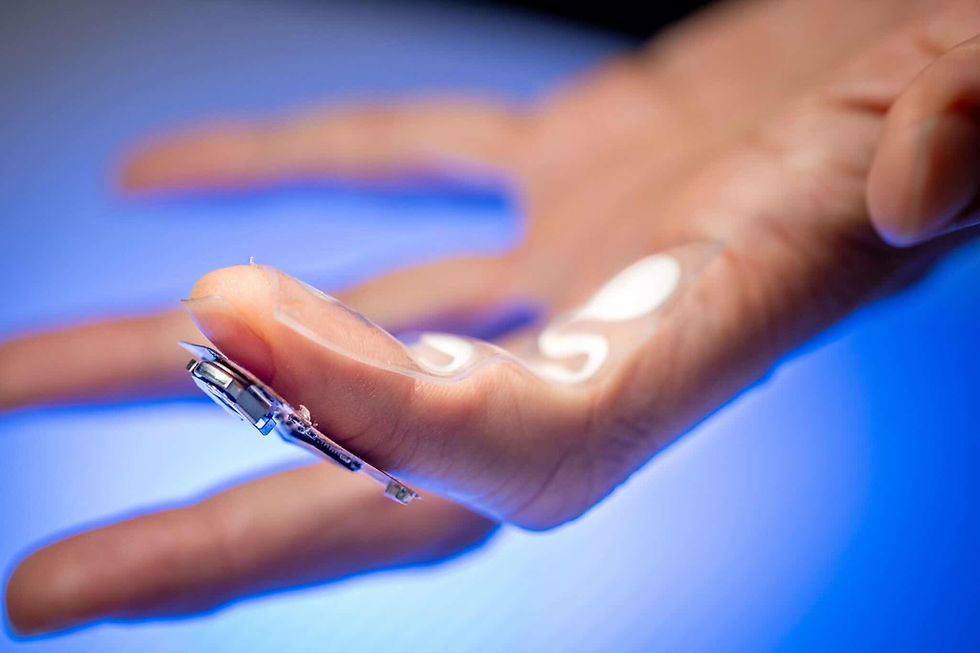
The wearable device for levodopa monitoring consists of a flexible printed circuit board (left) connected to an adhesive patch (right) that houses a sweat-collecting hydrogel (small white circle), a levodopa sensor (silver bands), and a paper microfluidic channel (wavy line). Credit: David Baillot/UC San Diego Jacobs School of Engineering
The great promise of this technology is to allow treatment to be monitored in real time and outside the hospital. Instead of relying solely on occasional consultations and blood tests, it would be possible to continuously monitor how each patient's body is responding to levodopa.
In the future, this type of monitoring could help doctors adjust the dose in a more individualized way and, in an even more advanced stage, be part of systems capable of monitoring the patient and automatically adjusting the treatment, creating a kind of closed loop.
For now, however, it is an experimental technology, and further studies are needed to determine how it will work in different clinical situations and during prolonged use.
LEIA MAIS:
A wearable patch for continuous levodopa monitoring in sweat: Towards exertion and power-free pharmacodynamic assessment in Parkinson’s disease
Tamoghna Saha, Muhammad Inam Khan, Katherine Longardner, Barak Sabbagh, Kaiwen Zheng, Hugo de Mendoza, Gaoyuan Ji, Bumsik Choi, Zongnan Wang, Rosie Pham, Michael Skipworth, Eshita Shah, Maria Reynoso, Chochanon Moonla, Abdulhameed Abdal, Debika Datta, Samar Singh Sandhu, Ponnusamy Nandhakumar, Artur Jedrzak, Shichao Ding, Lu Yin, Irene Litvan, and Joseph Wang,
Proceedings of the National Academy of Sciences. July 27, 2026. 123 (32) e2610453123
DOI: 10.1073/pnas.2610453123
Abstract:
Precision management of Parkinson’s disease (PD) requires frequent levodopa (L-dopa) dose adjustments, yet current monitoring relies on subjective symptom reporting and infrequent blood testing. Here, we present a soft, fingertip-mounted wearable platform for continuous, noninvasive L-dopa monitoring. By combining osmotically harvested passive sweat with soft hydrogels, a potentiometric sensing strategy, and individualized calibration, the platform estimates blood L-dopa information from sweat without external power or iontophoresis. Strong correlations between sweat and high-performance liquid chromatography (HPLC)-measured blood L-dopa concentrations were observed in healthy (Pr = 0.85) and PD subjects (Pr = 0.88) following a single immediate-release L-dopa/carbidopa dose. Low motor symptom scores aligned with peak L-dopa levels, confirming pharmacodynamic relevance. L-dopa cleared faster in PD patients despite similar bioavailability to healthy subjects, while recorded hemodynamic responses showed short hypotensive trends for both groups. Machine learning identified sweat and blood pressure as key contributors toward accurate estimation of blood L-dopa levels (mean absolute error = 2.02 µM vs. ground truth). Overall, our easy-to-use, energy-efficient wearable supports real-time, stimulation-free monitoring, potentially enabling at-home dosage adjustments and paving the way for future autonomous closed-loop L-dopa therapeutic system development.


Comments