Does Cannabis Reduce or Increase Alcohol Consumption? Science is Finally Starting to Answer

The use of cannabis and alcohol often occurs together, and while this can increase health risks, it also shows that, in some cases, cannabis can reduce alcohol consumption. An experimental study demonstrated that smoking cannabis with THC temporarily decreases the craving and amount of alcohol consumed. However, the authors state that more research is needed to fully understand this relationship.
In recent years, cannabis has become increasingly accepted due to legal changes in several countries. For this reason, it has become one of the most widely used psychoactive substances, second only to tobacco among people who consume alcohol and among those diagnosed with alcohol use disorder.
Cannabis use disorder often occurs concurrently with alcohol use disorder. Studies show that about 60% of people diagnosed with cannabis dependence or problematic use also meet the criteria for alcohol use disorder.
Furthermore, research suggests that cannabis use increases the chances of developing future alcohol problems, or that it hinders recovery and causes the disorder to persist.
The simultaneous use of cannabis and alcohol can occur in two different ways. One of them is concomitant use, when a person uses both substances in their life, but not at the same time. The other is simultaneous use, when the effects of the two substances overlap in the body because they are consumed together in the same period.

Research shows that using both substances is linked to higher alcohol consumption, more physical and psychological damage caused by alcohol, risky behaviors such as driving under the influence, the onset of psychiatric disorders, health problems, and difficulty achieving good results in alcohol dependence treatments.
Between these two types of use, simultaneous consumption appears to be the most dangerous because it increases immediate risks such as loss of control, accidents, or intoxication.
Despite these risks, there is a growing movement in the opposite direction, in which some people are using cannabis with the intention of reducing alcohol consumption. This idea is aligned with harm reduction strategies.
This social phenomenon has become known as "California sobriety" or "Cali sober." It is associated with the rapid development in the market of cannabis-based beverages, especially those containing THC, aimed at those who want to avoid or replace alcohol with something considered less harmful.

Despite extensive research, there is still no consensus on whether cannabis increases or decreases alcohol consumption, because many factors influence the relationship between the two substances. These factors include the ratio of different components of cannabis, such as THC and CBD, individual differences between people in treatment and those not seeking treatment, personal reasons for consuming each substance, and the order in which cannabis and alcohol are consumed at an event.
Among people undergoing treatment for alcohol dependence, there is evidence that cannabis use may hinder recovery. Interestingly, this negative effect does not appear to be linear, as studies show that occasional cannabis use during treatment is associated with worse outcomes, but very frequent use does not necessarily demonstrate the same detriment.
In some cases, it has been observed that heavy cannabis users did not have worse results in alcohol treatment than non-users.
Other research also shows that, in people undergoing treatment for alcohol use disorder, there are days when cannabis use is associated with a lower amount of alcohol consumed. Furthermore, individuals with a history of alcohol dependence appear to consume more alcohol only on the days they use cannabis, while those who use cannabis medicinally and daily tend to drink less and have fewer alcohol-related problems.

Observational studies have also shown that when a person starts the day using cannabis before alcohol, they are more likely to consume less alcohol that day. On the other hand, evidence also reveals that when a person stops using cannabis or greatly reduces consumption, there may be a temporary increase in alcohol use.
To better understand this relationship, controlled experimental studies are needed because they can assess cause and effect more accurately. Some laboratory studies have attempted to observe human behavior when using both substances, but most of them have focused on the interactions between substances in the body and the cognitive or motor impairment caused by the combination, and not on consumption behavior.
Animal studies suggest that THC, which is the main psychoactive component of cannabis, may reduce the desire for alcohol, but until now this had not been directly tested in humans. For this reason, the study described sought to analyze whether THC can alter the desire or consumption of alcohol in a controlled environment.

The research involved a total of 157 participants who consumed excessive amounts of alcohol and used cannabis at least twice a week. Participants underwent three separate sessions in which they smoked cannabis with different THC concentrations, including a placebo, and were then exposed to alcohol-related stimuli, such as images or smells, while being able to freely choose to drink during an experimental task.
The goal was to observe whether cannabis, especially with different THC levels, would increase or decrease the craving for alcohol or actual alcohol consumption.
The results showed that cannabis with higher THC reduced the immediate urge to consume alcohol and also reduced the amount consumed.
When compared to the placebo group, participants consumed approximately 19% less alcohol when using cannabis with an intermediate THC concentration and 27% less when the cannabis contained the highest THC content.
These results suggest that, at least in the short term, cannabis may reduce alcohol consumption after a period of abstinence.
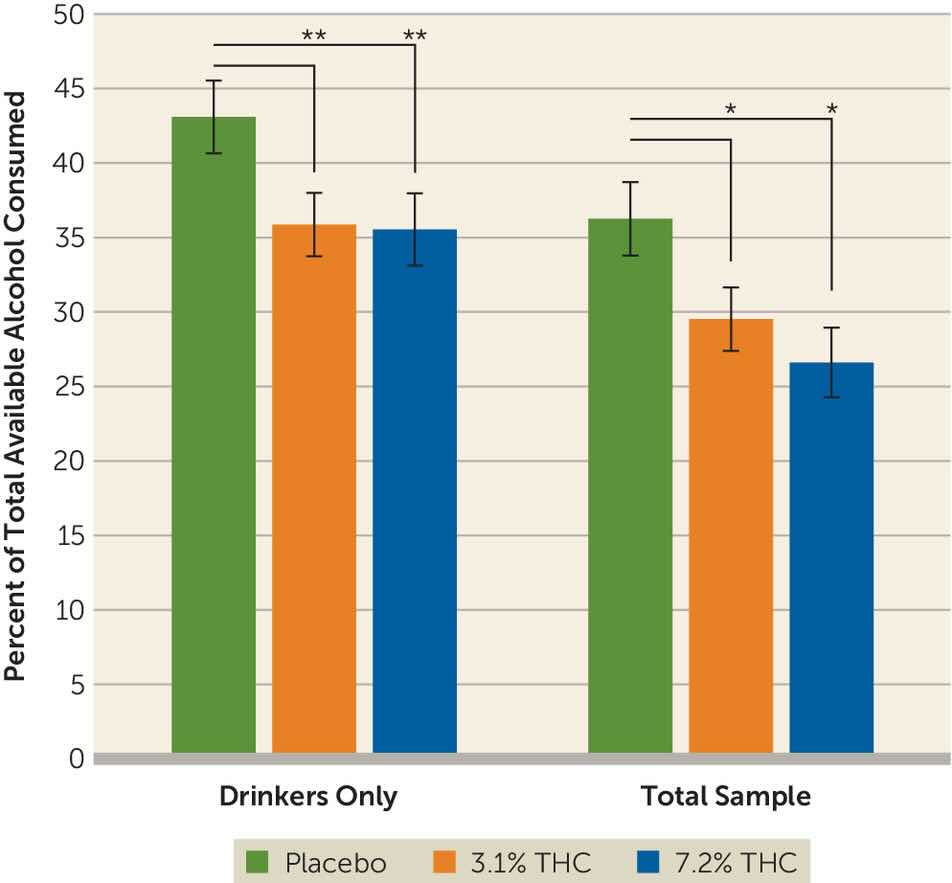
Therefore, the authors conclude that smoking cannabis after a period of abstinence may decrease immediate alcohol consumption. However, they emphasize that many questions remain unanswered and that more controlled research is needed to evaluate different substance combinations, user profiles, and the role of other cannabis components besides THC.
This information is essential for developing safe clinical guidelines, especially for people undergoing treatment for alcohol dependence.
READ MORE:
Acute Effects of Cannabis on Alcohol Craving and Consumption: A Randomized Controlled Crossover Trial
Jane Metrik, Elizabeth R. Aston, Rachel L. Gunn, Robert Swift, James MacKillop,
and Christopher W. Kahler
American Journal of Psychiatry. 18 November 2025
Abstract:
Cannabis use is strongly linked with heavy drinking and worse alcohol treatment outcomes; however, it may also contribute to decreased alcohol consumption. To date, no human studies have established a causal effect of cannabis on alcohol motivation. The aim of this double-blind crossover randomized clinical trial was to examine dose-dependent acute effects of delta-9-tetrahydrocannabinol (THC) on alcohol craving and consumption. Across three experimental days, 157 participants reporting heavy alcohol use and cannabis use two or more times weekly were randomized to smoke cannabis cigarettes containing 7.2% THC, 3.1% THC, or 0.03% THC (placebo), followed by exposures to neutral and personalized alcohol cues and an alcohol choice task for alcohol self-administration. A total of 138 participants completed two or more experimental sessions (mean age, 25.6 years [SD=5.1]; 35% women; 45% racial/ethnic minorities). Primary outcomes included craving, Alcohol Craving Questionnaire–Short Form, Revised (ACQ-SF-R), and an alcohol urge question; the secondary outcome was percent of total available milliliters of alcohol consumed. There were no significant effects of cannabis on ACQ-SF-R ratings after smoking and during alcohol cue exposure, but 7.2% THC reduced alcohol urge immediately after smoking. Participants consumed significantly less alcohol after smoking cannabis with 3.1% THC and 7.2% THC, reducing consumption by 19% and 27%, respectively. Following overnight cannabis abstinence, smoking cannabis acutely decreased alcohol consumption compared to placebo. Further controlled research on a variety of cannabinoids is needed to inform clinical alcohol treatment guidelines.


Comments