Depression May Not Be a Single Disease: Study Identifies Five Brain Profiles

Not everyone with depression experiences the same symptoms or responds to treatments in the same way. Researchers have now identified five distinct patterns of brain activity associated with different symptom profiles, opening up a potential new direction for more personalized treatments.
Depression does not manifest the same way in every individual. Some people primarily experience sadness and a loss of interest, while others may struggle with concentration, anxiety, repetitive thoughts, or difficulty carrying out daily activities. This variability may be one reason why a treatment works well for some people but is less effective for others.
For this reason, researchers are investigating whether there are distinct, identifiable patterns of depression within the brain. In a new study, they discovered five unique brain profiles, each linked to a specific combination of brain alterations and symptoms.
To identify these patterns, the researchers studied 263 individuals with depression and 75 individuals without the disorder. Participants remained at rest during a magnetoencephalography scan, a technique that records the minute magnetic fields generated by the brain's electrical activity.
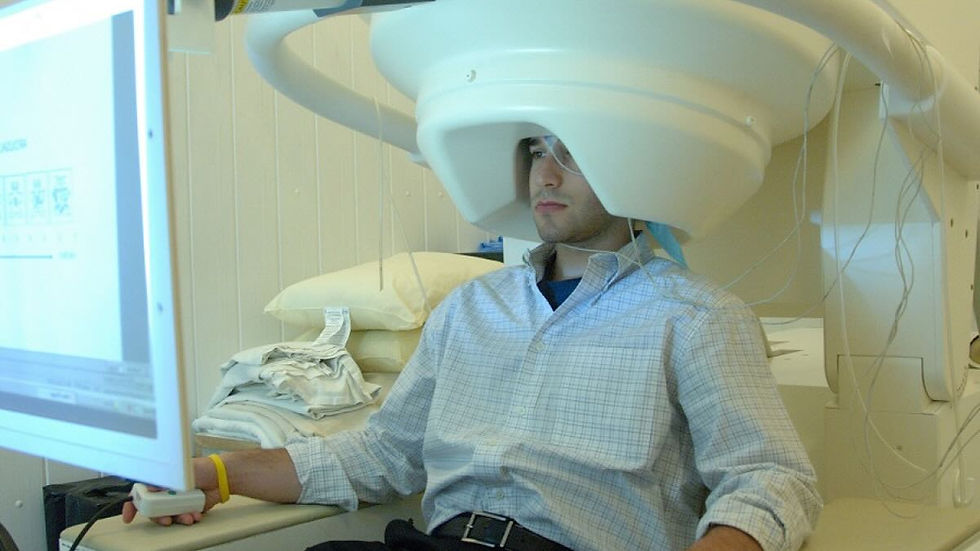
Magnetoencephalography examination
The researchers also performed MRI scans to observe brain structure and used clinical assessments to identify symptoms. The main goal was to discover how different regions of the brain were functioning and communicating with each other.
Scientists mainly analyzed brain oscillations, which are rhythms produced by the coordinated activity of groups of neurons. They observed how these rhythms were synchronized between different regions. This synchronization is called functional connectivity and indicates that different areas are showing related activity. Then, a mathematical method called clustering compared the participants and brought together those who showed similar brain patterns. Thus, five groups emerged.
The first group had relatively strong connectivity between several regions and broad and intense symptoms, including depression, anxiety, rumination and great difficulty carrying out daily activities. The second group had generally weaker connectivity and milder depression symptoms compared to the other groups.

The third group showed a very broad reduction in communication between different brain regions and was notable for the presence of symptoms related to post-traumatic stress disorder. The fourth group exhibited a more mixed pattern: some brain regions showed increased communication, while others showed reduced communication. These individuals experienced severe depression, substance use-related issues, and a very low overall sense of well-being.
The fifth group, meanwhile, displayed the strongest connectivity between brain regions of all the groups. These individuals also faced significant substance use-related problems, but they exhibited fewer trauma-related symptoms.

These results do not mean that there are officially five types of depression or that a brain scan can already tell which treatment a person should receive. The groups still need to be confirmed in other studies and in different populations. Even so, the work reinforces an important idea: people who receive the same diagnosis of depression can present very different brain patterns and combinations of symptoms.
In the future, understanding these differences could help researchers discover why certain treatments work for some people and not others, bringing psychiatry closer to more personalized strategies.
READ MORE:
Magnetoencephalography oscillation-based functional connectivity identifies clinically relevant depression phenotypes
Liu (刘文雅), Maria Vesterinen, Alexandra Andersson, Paula Partanen, Samanta Knapič, Joonas J. Juvonen, Felix Siebenhühner, Antti Salonen, Hanna Renvall, Risto J. Ilmoniemi, Eero Castrén, Erkki Isometsä, Dimitri Van De Ville, J. Matias Palva, and Satu Palva
Nature Mental Health (2026)
DOI: 10.1038/s44220-026-00723-4
Abstract:
Heterogeneity in clinical presentation and mechanisms of major depressive disorder (MDD) probably contributes to limited responses to current treatments in many patients. Identifying biologically meaningful phenotypes would constitute a major step towards the development of personalized treatment approaches. Brain-activity-based phenotyping offers a promising route toward this goal. In particular, brain oscillations—rhythmic patterns of neural activity that support information processing—have been implicated in depression but have not previously been used to define biological phenotypes of the disorder. Yet, no studies have used brain oscillations to identify biological depression phenotypes. Here we report data-driven identification of oscillation phenotypes for MDD. We conducted a cross-sectional study and collected resting-state magnetoencephalography (MEG), structural magnetic resonance imaging and clinical symptom data from 263 patients with MDD and 75 healthy controls. We assessed oscillation-based functional connectivity from source-reconstructed MEG data with two coupling-mode measures and computed their low-dimensional brain–symptom associations to obtain latent components. Using clustering methods on these components, we identified five depression phenotypes that were characterized by distinct spectral and spatial patterns and differentiated clinically unique symptom profiles. These findings suggest that MEG-based oscillatory connectivity captures clinically relevant heterogeneity in MDD and provides candidate mechanistic phenotypes for future validation and treatment-stratification studies.


Comments