Brain Strengthening With Exercise: Cycling Shows Real Effect On Parkinson's

Studies show that physical exercise, such as cycling, can help people with Parkinson's not only with movement but also with brain function. An experiment with patients wearing brain electrodes showed that, after a few weeks of training, there were positive changes in areas of the brain linked to the disease, similar to the effects of medication. This indicates that regular exercise may play an important role in treatment and long-term brain health.
Parkinson's disease (PD) affects about 10 million people worldwide and is best known for causing tremors, slow movements, and balance difficulties. The most commonly used treatments today are medications that replace dopamine (such as levodopa) and surgeries that stimulate parts of the brain with small electrical shocks.
But, in addition to these treatments, researchers have found that physical exercise, such as physical therapy, walking, or cycling, can also be very helpful. Exercise improves strength, balance, gait, and even symptoms such as memory and mood.
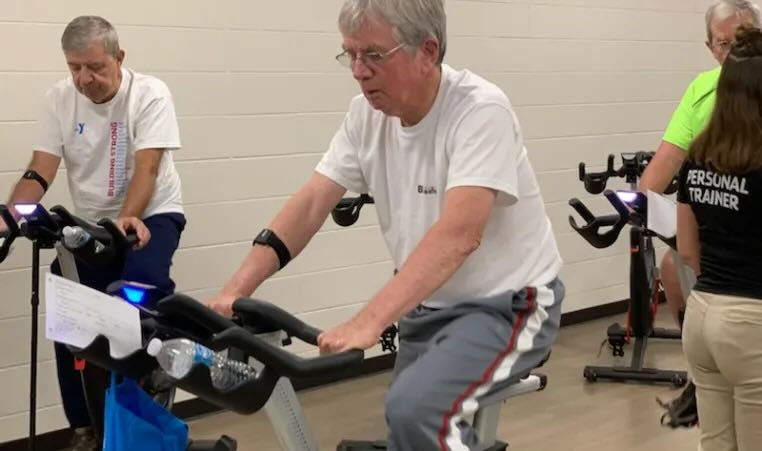
This is because exercise helps the brain protect and recover by stimulating substances that promote neuronal health. Although the physical benefits are visible, it's still unclear exactly how exercise changes brain function in people with Parkinson's.
To better understand this, scientists studied a group of people with Parkinson's who had already undergone deep brain stimulation surgery, a procedure in which electrodes are placed in the brain to control symptoms.
During a 12-session program over a four-week period of cycling on a special bicycle, the researchers measured electrical signals from a region of the brain called the subthalamic nucleus (STN), which is directly involved in Parkinson's. They took these measurements before and after each exercise to observe how the brain responded in the short and long term.
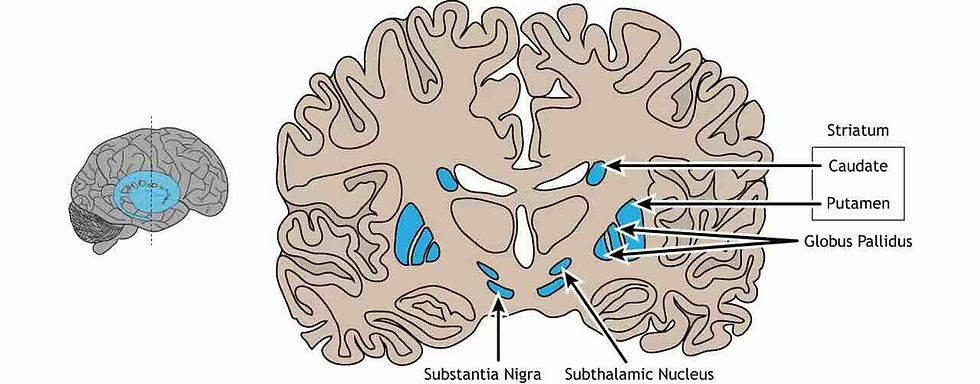
The results showed that, although exercise did not cause immediate changes in brain signals, over time there were significant changes in the upper part of the subthalamic nucleus, indicating that this area was being "trained" and responding to exercise.
These changes in signals were similar to the effects of Parkinson's medications, suggesting that exercise may play a similar role in improving symptoms.
Interestingly, the lower part of the subthalamic nucleus did not change with exercise, indicating that the effects are more specific and targeted. This reinforces the idea that, even if the results are not immediate, regular exercise can reprogram the brain and help manage the disease.
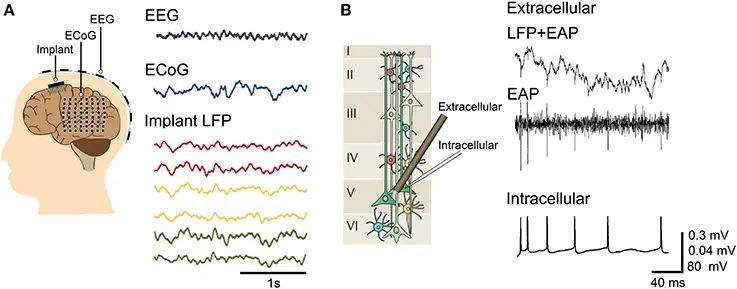
Types of neural signals: action potentials and field potentials recorded extracellularly (A) and intracellularly (B).
READ MORE:
Electrophysiological correlates of dynamic cycling in Parkinson’s disease
Prajakta Joshi, Lara Shigo, Brittany Smith, Camilla W. Kilbane, Aratrik Guha, Kenneth Loparo, Angela L. Ridgel, and Aasef G. Shaikh
Clinical Neurophysiology. Volume 174, June 2025, Pages 17-27
Abstract:
Physical exercise like dynamic cycling has shown promise in enhancing motor function in Parkinson’s disease (PD). We examined the underlying mechanisms of dynamic cycling in PD, emphasizing its impact on the activity of the subthalamic nucleus (STN), a pivotal region within the basal ganglia. The investigation involved 100 dynamic cycling sessions conducted among nine PD individuals. Each participant underwent a maximum of 12 sessions over a four-week period. Local field potentials (LFPs) originating from the STN were recorded before and after cycling, utilizing DBS electrodes positioned within the nucleus. We evaluated both immediate and sustained impacts of dynamic cycling on LFP. The periodic LFP activity was assessed by determining the dominant spectral frequency and the power associated with that frequency. Aperiodic LFP activity was analyzed by calculating the 1/f exponent of the power spectrum. Immediate and sustained effects of dynamic cycling on LFPs were evaluated. While immediate changes were insignificant, long-term effects showed an increasing trend in power and the 1/f exponent of the power spectrum, a measure of fluctuation in the signal, in the dorsolateral region of the STN. Ventral region of the STN did not show a significant response to the exercise intervention. These results highlight the impact of dynamic cycling on STN neuronal activity in PD. Prolonged interventions, even without immediate changes, bring about significant modifications, emphasizing the role of extended exercise in PD management and neuroplasticity. These results highlight the impact of dynamic cycling showing changing in the STN neurophysiology in PD.


Comments